

I’m kind of obsessed with talking about dopamine.
Ever since I read Dopamine Nation in 2023, I’ve been catching myself in two moments:
When I’m in dopamine overdrive—stacking pleasures, riding the high.
When I’m in the inevitable comedown, wondering why everything suddenly feels flat.
Knowing this cycle has been one of the most useful tools in my creative life.
It’s helped me recognize when I’m about to burn myself out chasing highs…
And when I need to lean into the slow, unglamorous part of making things.
Your brain runs on a pleasure-pain seesaw
Neuroscientist Anna Lembke calls it the "pleasure-pain balance" in Dopamine Nation.
Every surge of dopamine—whether from a creative breakthrough, a flood of likes, or the thrill of starting something new—is followed by an equal and opposite dip.
Lembke goes further: in a world of constant stimulation (notifications, streaming, endless scrolling), we've trained our brains to need more to feel less. The baseline dulls, so we chase ever-bigger spikes. For creatives, that means the early rush of a project rarely feels "enough" anymore.
The bigger the spike, the deeper the dip.
And too many spikes in a row make everyday work feel lifeless by comparison.
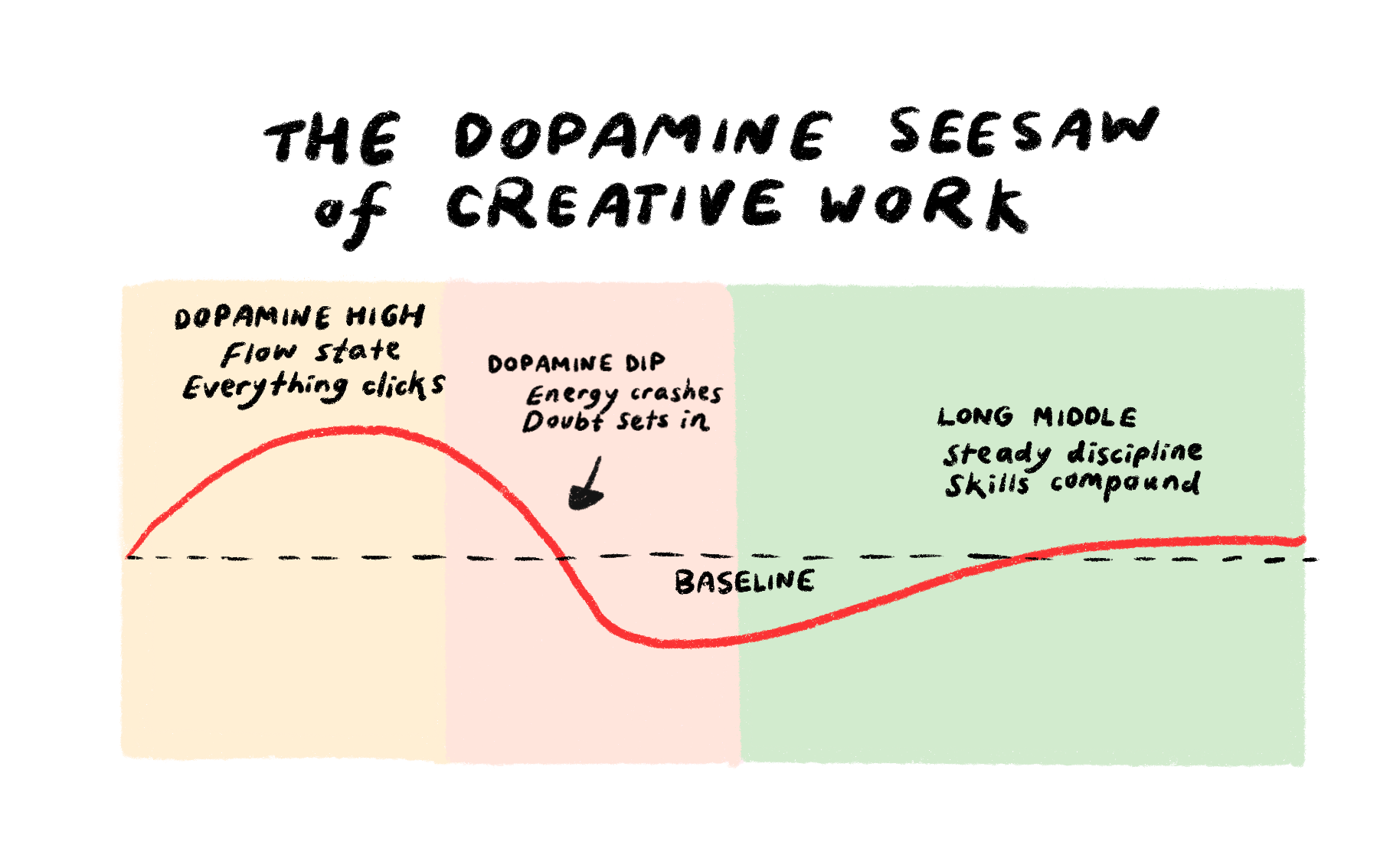
Every creative project follows the same three phases
High Phase - Inspiration strikes. You're in deep flow. Everything feels possible.
Dip Phase - The novelty fades. Progress slows. Doubt creeps in. You look for your next hit of excitement.
The Long Middle - Steady work, small gains, no rush. This is where most people quit—not because they lack talent, but because they've trained their brains to rely on constant highs.
The long middle is where the real work happens
The Long Middle is where the work shifts from adrenaline to discipline. It's the poet rewriting the same stanza fifteen times until the rhythm lands. The designer trying ten variations of a logo no one will see. The guitarist practicing scales they'll never play on stage, just to loosen a stubborn finger.
It can feel boring, even pointless, but this is where:
Style emerges through repetition, not revelation.
You build tolerance for the discomfort of uncertainty.
You learn to create without the constant reward of novelty or applause.
Without the Long Middle, you get a string of abandoned starts instead of a body of work.
You can train your brain to need fewer highs
Keep something just for you. When you share everything you make, your brain starts to expect the dopamine hit of likes and comments. Try keeping a sketchbook, or voice memo stash that no one sees. At first, it feels oddly private, almost lonely—then it becomes liberating. You remember what it's like to make without performance pressure.
Practice boredom. Boredom is the compost pile of creativity. Go for a walk without headphones. Wait in line without pulling out your phone. One designer I know got her best client concept while sitting in traffic. Her brain had finally stopped being fed, so it went digging for scraps and stumbled on gold.
Rest after big pushes. After a major project, launch, or all-nighter, resist the urge to fill the gap immediately. Resisting the gap helps maintain your nervous system, especially when it’s used to constant stimulation. The rest period helps your baseline reset so the next high feels fresh instead of forced.
Understanding this cycle changes everything
If you don't understand the dopamine seesaw, you'll misread the dip as failure and keep chasing the next rush.
You'll live in a loop of highs and crashes, but never stay long enough in the Long Middle to see what your work could really become.
The creatives who last aren't the ones who can summon inspiration on command.
They're the ones who can ride out the flat days, keep shaping the work, and let the thrill return on its own.
You can be someone who makes things.
Or you can be someone who chases creative highs.
Knowing this cycle is what makes the difference.
Note: This cycle doesn’t apply to only creative work. The dopamine seesaw shows up everywhere—falling in love, buying something new, even getting a sudden burst of social attention. The phases change, but the brain chemistry stays the same.
—Danbee